
AI Consultancy
Beginner’s Guide to LLM Prompting
Welcome to LLM Prompting Fundamentals
Master the basics of Large Language Model prompting in 8 comprehensive modules
Module 1: What is an LLM?
Learning Objectives:
- Understand what Large Language Models are
- Recognise common LLM capabilities
- Identify real-world applications
What is a Large Language Model?
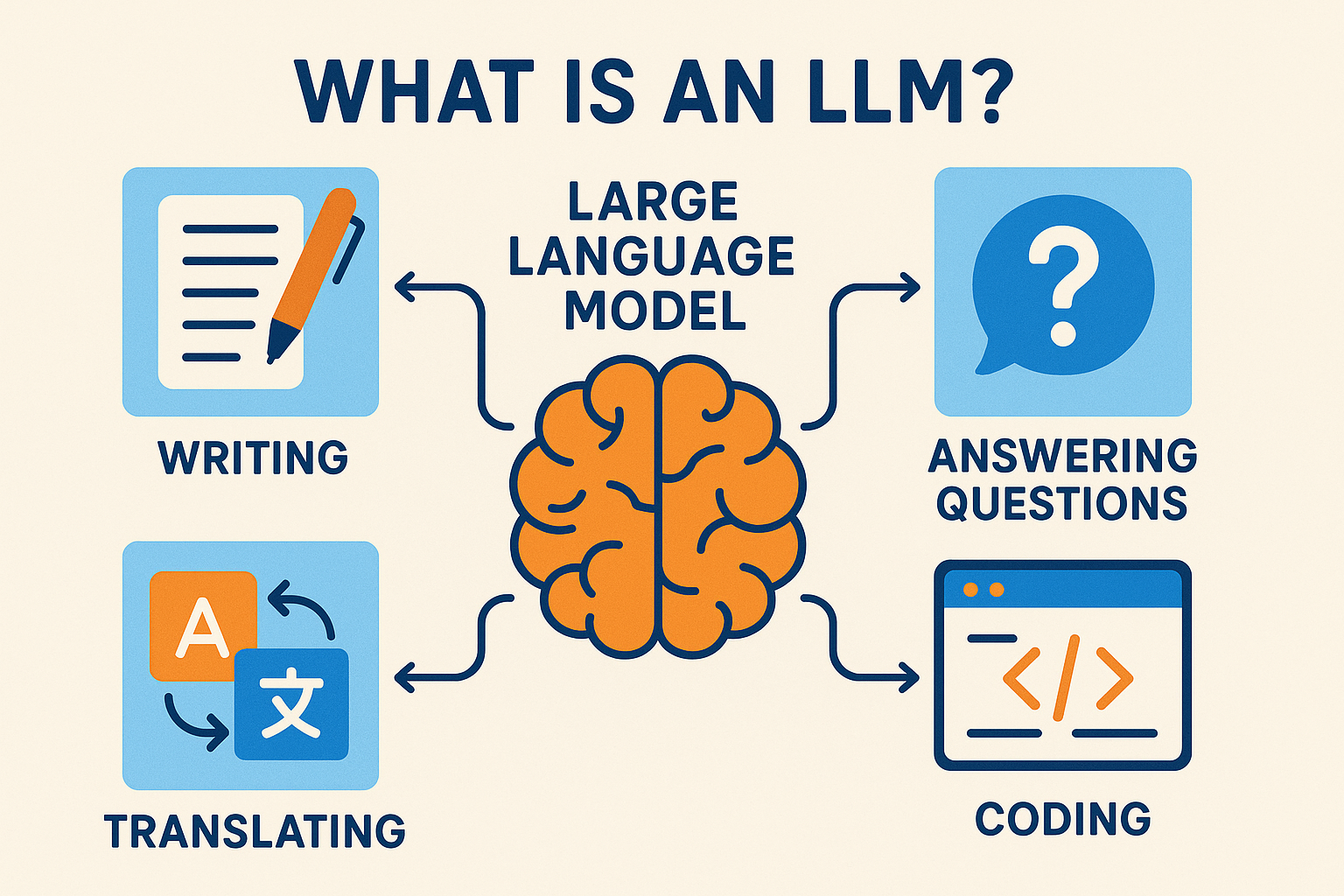
A Large Language Model (LLM) is an artificial intelligence system trained on vast amounts of text data to understand and generate human-like language. Think of it as a very sophisticated autocomplete system that can engage in conversations, answer questions, write content, and help solve problems.
Key Capabilities:
Text Generation
Writing articles, stories, emails, and reports
Question Answering
Providing information and explanations
Language Translation
Converting text between languages
Code Generation
Writing and debugging programming code
Real-World Example:
“Imagine you’re writing an email to a client but can’t find the right tone. An LLM can help you draft professional, friendly, or formal versions of the same message, saving you time and ensuring clear communication.”
Quick Knowledge Check
1. What does LLM stand for?
2. Which is NOT a common LLM capability?
Module 2: What is a Prompt?
Learning Objectives:
- Define what a prompt is in AI context
- Understand the role of prompts in AI communication
- Recognise different types of prompts
What is a Prompt?
A prompt is simply the instruction, question, or input you give to an AI system to get a desired response. Think of it as having a conversation with a very knowledgeable assistant – the clearer your question or request, the better the response you’ll receive.
Analogy: The Restaurant Order
Vague Prompt: “I want food” (like saying “give me something” to a waiter)
Clear Prompt: “I’d like a medium rare steak with roasted vegetables and a side salad” (specific and detailed)
The more specific you are, the more likely you’ll get exactly what you want!
How Prompts Work:
1. You Input
Your question or instruction
2. AI Processes
Analyses and understands your request
3. AI Responds
Provides relevant answer or content
Example Prompts:
Question Prompt:
“What are the benefits of regular exercise?”
Instruction Prompt:
“Write a professional email declining a meeting invitation.”
Creative Prompt:
“Create a short story about a robot learning to garden.”
Quick Knowledge Check
1. A prompt is best described as:
2. True or False: Vague prompts typically produce better results than specific ones.
Module 3: How Do Prompts Work?
Learning Objectives:
- Understand the AI interaction process
- Learn how AI interprets and responds to prompts
- Recognise factors that influence AI responses
The Prompt-Response Process
Input Prompt
You provide instruction
AI Analysis
Processes your request
Generate Response
Provides relevant output
What Happens Behind the Scenes?
Step 1: Understanding Context
The AI reads your prompt and identifies key information, intent, and requirements.
Step 2: Knowledge Retrieval
The AI draws from its training data to find relevant information and patterns.
Step 3: Response Generation
The AI constructs a response that best matches your request and context.
Factors That Influence Responses
Clarity
How clear and specific your instructions are
Context
Background information you provide
Length
How detailed your prompt is
Style
The tone and format you request
Practical Example
Let’s see how the same request can produce different results:
Vague Prompt:
“Tell me about cars”
Result: Generic information about automobiles
Specific Prompt:
“Explain the benefits of electric cars for families in the UK, focusing on cost savings and environmental impact”
Result: Targeted, relevant information perfect for your needs
Quick Knowledge Check
1. What is the first step in the AI prompt processing?
2. Which factor does NOT typically influence AI responses?
Module 4: Prompting Do’s and Don’ts
Learning Objectives:
- Master essential prompting best practices
- Avoid common prompting mistakes
- Apply effective prompting strategies
DO’s
Be Specific and Clear
Provide detailed instructions rather than vague requests
Provide Context
Give relevant background information to help the AI understand your needs
Specify Format
Tell the AI how you want the response formatted
Set Tone and Style
Indicate the desired tone (professional, casual, friendly, etc.)
Include Examples
Show the AI what you’re looking for with examples
DON’Ts
Don’t Be Vague
Avoid unclear or ambiguous instructions
Don’t Assume Knowledge
Don’t assume the AI knows your specific context or preferences
Don’t Use Contradictory Instructions
Avoid conflicting requirements in the same prompt
Don’t Ignore Response Length
Specify desired length to avoid overly long or short responses
Don’t Expect Mind Reading
The AI can’t guess your unstated preferences or requirements
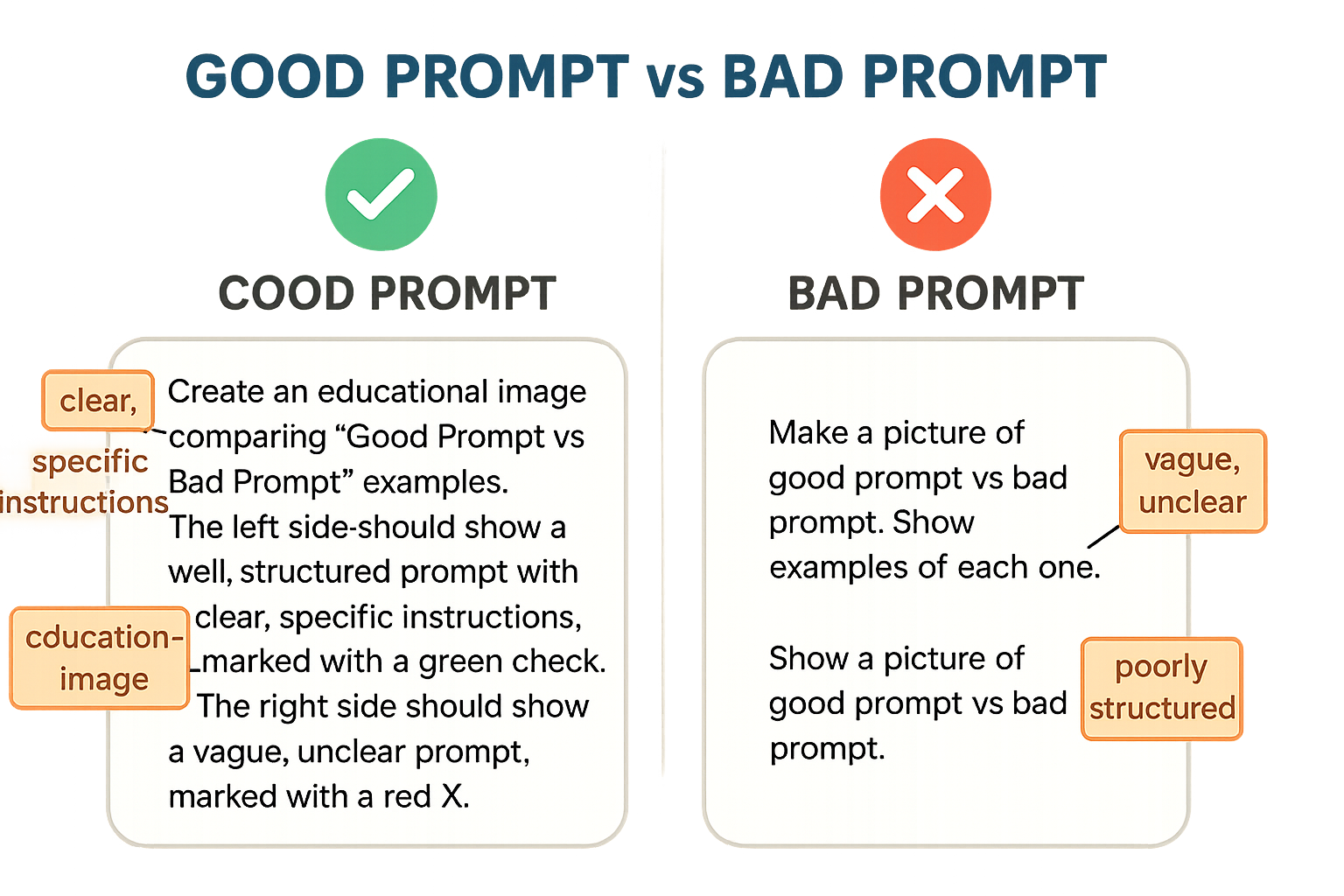
Practical Comparison
Scenario: You need help with a job application email
❌ Poor Prompt:
“Write an email about the job.”
Issues: Too vague, no context, no format specified
✅ Excellent Prompt:
“Write a professional job application email for a Marketing Manager position at a tech company. Include my enthusiasm for the role, mention my 3 years of digital marketing experience, and request an interview. Keep it concise (under 150 words) with a formal but friendly tone.”
Strengths: Specific role, context, requirements, length, tone
Quick Knowledge Check
1. Which is an example of a good prompting practice?
2. What should you avoid when writing prompts?
Module 5: Structure of a Good Prompt
Learning Objectives:
- Master the three-part prompt structure
- Learn how to build effective prompts systematically
- Apply the framework to real-world scenarios
The Three-Part Framework
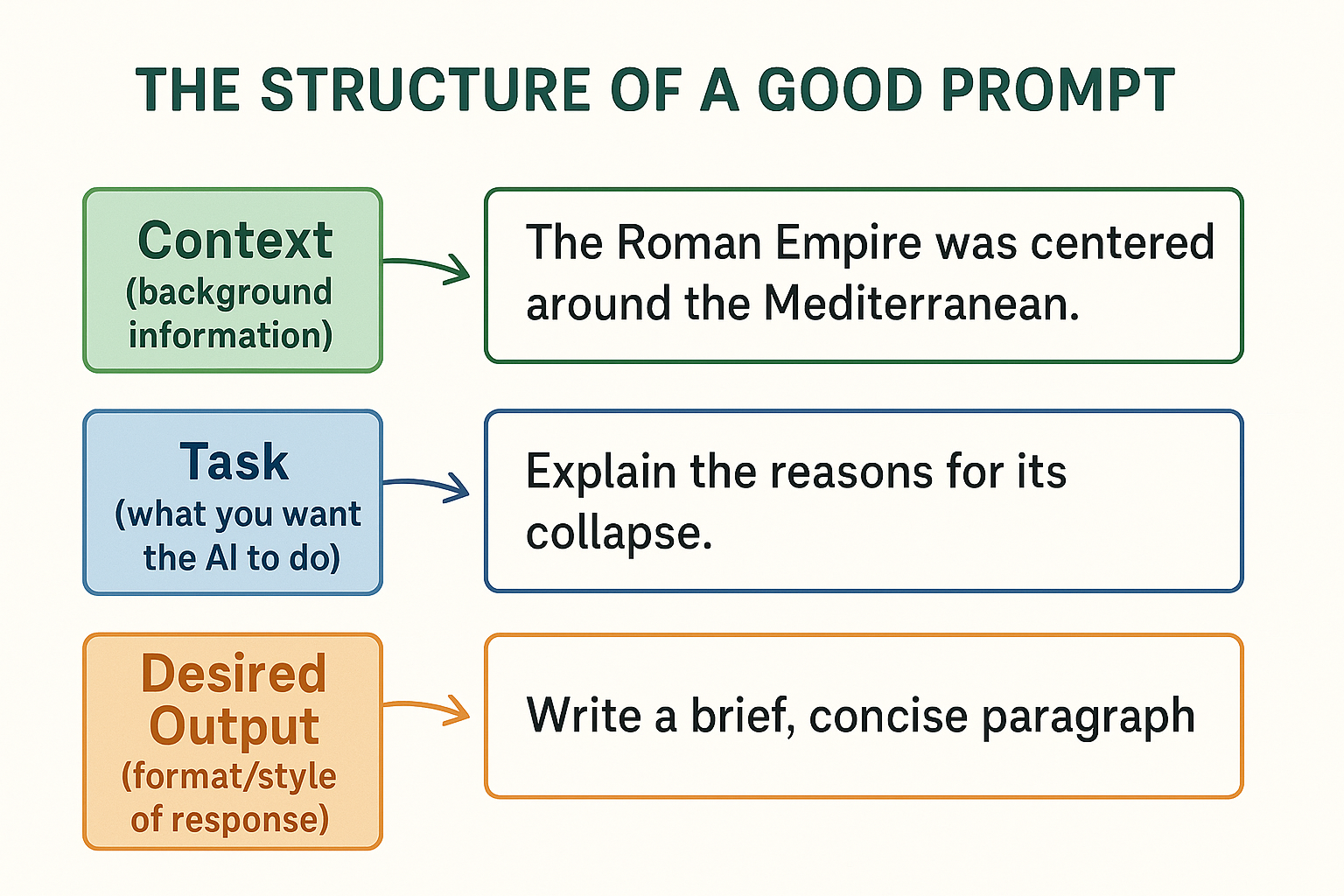
Every effective prompt should include three key components that work together to produce the best results:
Context
Provide background information and set the scene. Help the AI understand the situation, your role, and any relevant details.
Example: “I’m a small business owner running a local bakery. We’ve been operating for 2 years and want to expand our customer base.”
Task
Clearly state what you want the AI to do. Be specific about the action you need performed.
Example: “Create a social media marketing strategy that focuses on Instagram and Facebook to attract more local customers.”
Desired Output
Specify the format, style, length, and tone you want for the response.
Example: “Present this as a step-by-step plan with 5 actionable strategies. Include estimated time investment for each strategy. Use a professional but friendly tone.”
Complete Example
Putting It All Together:
“I’m a small business owner running a local bakery. We’ve been operating for 2 years and want to expand our customer base.”
“Create a social media marketing strategy that focuses on Instagram and Facebook to attract more local customers.”
“Present this as a step-by-step plan with 5 actionable strategies. Include estimated time investment for each strategy. Use a professional but friendly tone.”
Template You Can Use
Prompt Template:
Context: [Your situation/role/background information]
Task: [What you want the AI to do]
Output: [Format, style, length, tone requirements]
Practice Exercise
Try This Yourself:
Imagine you need help writing a cover letter for a job application. Use the three-part structure to create your prompt:
Quick Knowledge Check
1. What are the three components of a well-structured prompt?
2. Which component helps the AI understand your situation and background?
Module 6: Types of Prompts
Learning Objectives:
- Identify different types of prompts and their uses
- Choose the right prompt type for your needs
- Apply various prompt formats effectively
Main Categories of Prompts
Question Prompts
Direct questions that seek specific information or explanations.
When to Use:
- Seeking factual information
- Getting explanations
- Understanding concepts
Examples:
- “What are the benefits of renewable energy?”
- “How does photosynthesis work?”
- “Why is exercise important for health?”
Instruction Prompts
Direct commands that tell the AI to perform specific tasks or create content.
When to Use:
- Creating content
- Generating lists
- Writing documents
- Solving problems
Examples:
- “Write a professional email apologising for a delayed delivery”
- “Create a 5-step guide for changing a tyre”
- “Generate 10 creative names for a pet cat”
Example-Based Prompts
Show the AI what you want by providing examples, then ask it to create similar content.
When to Use:
- Matching a specific style
- Following a pattern
- Maintaining consistency
- Complex formatting
Example:
“Here are examples of our social media style:
• ‘Monday motivation! Start your week strong 💪 #MondayMotivation’
• ‘Sharing some weekend inspiration! What’s your favourite way to relax? 😊 #WeekendVibes’
Create 3 similar posts about healthy eating.”
Role-Based Prompts
Ask the AI to take on a specific role or perspective to provide more targeted responses.
When to Use:
- Expert advice needed
- Specific perspectives
- Professional contexts
- Audience-specific content
Examples:
- “As a financial advisor, explain the benefits of saving for retirement”
- “Acting as a fitness trainer, create a beginner workout plan”
- “From a teacher’s perspective, suggest ways to help children with maths”
Choosing the Right Prompt Type
Consider Your Goal:
- Need information? → Use Question prompts
- Want content created? → Use Instruction prompts
- Need specific style? → Use Example-based prompts
- Want expert perspective? → Use Role-based prompts
Pro Tips:
- • You can combine prompt types
- • Start simple, then add complexity
- • Match the type to your audience
- • Practice with different types
Real-World Application
Scenario: Planning a Birthday Party
Question Prompt: “What are some popular themes for a 10-year-old’s birthday party?”
Instruction Prompt: “Create a checklist for organising a children’s birthday party for 15 guests.”
Example-Based: “Based on this invitation style: ‘Join us for magical fun! Sarah turns 10!’ Create similar invitations for different themes.”
Role-Based: “As an experienced children’s party planner, suggest 5 engaging activities for 10-year-olds.”
Quick Knowledge Check
1. Which prompt type is best for seeking factual information?
2. When would you use a role-based prompt?
Module 7: Writing Your First Prompt
Learning Objectives:
- Apply the prompt structure framework hands-on
- Practice writing effective prompts
- Learn to refine and improve your prompts
Step-by-Step Prompt Writing Process
Let’s Write a Prompt Together!
Scenario: You need help creating a healthy meal plan for the week.
Step 1: Define Your Context
Think about your situation and provide relevant background:
“I’m a busy professional working from home. I have 30 minutes for meal prep on Sundays and prefer simple, nutritious meals. I don’t eat red meat but enjoy chicken, fish, and vegetarian options.”
Step 2: Specify Your Task
Clearly state what you want the AI to do:
“Create a healthy 7-day meal plan that includes breakfast, lunch, and dinner options.”
Step 3: Define Your Desired Output
Specify format, style, and any special requirements:
“Present this as a weekly calendar format with simple recipes that take 20 minutes or less to prepare. Include a shopping list organised by food category.”
Your Complete Prompt
“I’m a busy professional working from home. I have 30 minutes for meal prep on Sundays and prefer simple, nutritious meals. I don’t eat red meat but enjoy chicken, fish, and vegetarian options.
Create a healthy 7-day meal plan that includes breakfast, lunch, and dinner options.
Present this as a weekly calendar format with simple recipes that take 20 minutes or less to prepare. Include a shopping list organised by food category.”
Now It’s Your Turn!
Practice Exercise: Plan a Weekend Trip
Use the three-part structure to write a prompt for planning a weekend trip to a nearby city.
Refining Your Prompts
⚠️ If Your Response Is:
- Too vague: Add more specific details to your context and task
- Too long: Specify word/character limits in your output requirements
- Wrong format: Be more explicit about the structure you want
- Off-topic: Review your task description for clarity
✅ Refinement Tips:
- Be specific: Use precise numbers, dates, and requirements
- Set boundaries: Indicate what to include/exclude
- Specify tone: Professional, casual, friendly, etc.
- Include examples: Show the AI what success looks like
Quick Reference Checklist
Before Sending Your Prompt, Check:
Context Section:
- □ Background information provided
- □ Relevant constraints mentioned
- □ Your role/situation clarified
Task Section:
- □ Clear action verb used
- □ Specific goal stated
- □ Scope defined
Output Section:
- □ Format specified
- □ Length indicated
- □ Tone/style mentioned
Overall:
- □ No contradictory instructions
- □ Clear and concise
- □ Realistic expectations
Quick Knowledge Check
1. What should you do if the AI’s response is too vague?
2. Which is the correct order for the three-part prompt structure?
Module 8: Common Pitfalls and How to Avoid Them
Learning Objectives:
- Identify common beginner prompting mistakes
- Learn troubleshooting techniques
- Develop strategies for continuous improvement
Top 8 Common Pitfalls
1. Being Too Vague
❌ Problem: “Help me with my work”
Too general – the AI doesn’t know what kind of work or what help you need
✅ Solution: “Help me write a professional email to postpone a client meeting scheduled for tomorrow”
Specific task with clear context
2. Information Overload
❌ Problem: Including too much irrelevant information that confuses the AI
Example: Adding your life story when asking for a recipe
✅ Solution: Include only relevant context that directly relates to your request
Focus on what the AI needs to know to help you
3. Contradictory Instructions
❌ Problem: “Write a brief detailed report”
“Brief” and “detailed” contradict each other
✅ Solution: “Write a concise 200-word report covering the key points”
Clear and specific without contradictions
4. Assuming AI Knowledge
❌ Problem: “Update my C.V with the new skills”
AI doesn’t have access to your existing C.V or know what new skills you mean
✅ Solution: “Help me add Python programming and data analysis to my C.V in the skills section”
Provides all necessary information
5. Not Specifying Format
❌ Problem: “Give me tips for saving money”
Could result in a paragraph, essay, or random list
✅ Solution: “Give me 5 practical money-saving tips in bullet points with brief explanations”
Clear format and structure specified
6. Unrealistic Expectations
❌ Problem: Expecting the AI to know real-time information or perform actions it can’t do
Example: “Book me a table at the best restaurant tonight”
✅ Solution: “Suggest 5 highly-rated restaurants in Manchester with contact details for booking”
Asks for information the AI can provide
7. Ignoring Tone and Style
❌ Problem: Not specifying the tone, resulting in inappropriate style for your audience
Formal response when you needed casual, or vice versa
✅ Solution: “Write in a friendly, conversational tone suitable for social media”
Clear guidance on appropriate style
8. Not Iterating and Improving
❌ Problem: Accepting the first response even if it’s not quite right
Missing opportunities to get exactly what you need
✅ Solution: “That’s good, but could you make it more formal and add specific examples?”
Build on the response to improve it
Troubleshooting Guide
When Things Go Wrong:
If the response is…
Too generic: Add more specific context
Wrong tone: Specify the tone you need
Too long/short: Set clear length requirements
Wrong format: Be explicit about structure
Off-topic: Clarify your main objective
Quick fixes:
• Ask for clarification: “Could you explain that differently?”
• Request adjustments: “Make it more [specific requirement]”
• Provide feedback: “That’s helpful, but I also need…”
• Give examples: “Something more like this…”
• Break it down: “Let’s focus on just the first part”
Success Strategies
Start Specific
Begin with detailed prompts rather than trying to be brief
Think Conversation
Treat prompting as a conversation – you can always follow up
Keep Learning
Each interaction teaches you what works better
Quick Knowledge Check
1. What should you do if an AI response is not quite what you wanted?
2. Which is an example of contradictory instructions?
Course Summary & Further Learning
Congratulations!
You’ve completed the Beginner’s Guide to LLM Prompting. You now have the fundamental skills to communicate effectively with AI systems and get the results you want.
What You’ve Learned:
Core Concepts:
- Understanding LLMs and their capabilities
- The role of prompts in AI communication
- How AI processes and responds to prompts
- Essential prompting best practices
Practical Skills:
- Three-part prompt structure (Context-Task-Output)
- Different types of prompts and their uses
- Writing effective prompts from scratch
- Troubleshooting and improving responses
External References for Further Study
1. OpenAI’s GPT Guide
Comprehensive guide to understanding and using GPT models effectively.
platform.openai.com/docs/guides/prompt-engineeringOfficial documentation covering advanced prompting techniques, best practices, and real-world applications.
2. Learn Prompting – Comprehensive Course
Free, open-source course covering beginner to advanced prompting techniques.
learnprompting.orgCommunity-driven resource with modules on prompt engineering, applications, and the latest research developments.
3. Anthropic’s Prompt Engineering Guide
Research-based approach to effective AI communication and prompt design.
docs.anthropic.com/claude/docs/prompt-engineeringEvidence-based techniques from AI safety and alignment research, focusing on clear and effective prompting.
Next Steps in Your AI Journey
Continue Learning:
- • Practice with different AI platforms
- • Explore advanced prompting techniques
- • Join AI and prompting communities
- • Experiment with creative applications
Apply Your Skills:
- • Use AI for work and personal projects
- • Help colleagues improve their prompting
- • Document what works best for you
- • Stay updated with AI developments
Citations and References
Academic and Professional Sources:
- 1. Brown, T., Mann, B., Ryder, N., et al. (2020). “Language Models are Few-Shot Learners.” Advances in Neural Information Processing Systems, 33, 1877-1901.
- 2. Wei, J., Wang, X., Schuurmans, D., et al. (2022). “Chain-of-Thought Prompting Elicits Reasoning in Large Language Models.” Advances in Neural Information Processing Systems, 35, 24824-24837.
- 3. OpenAI. (2023). “GPT-4 Technical Report.” arXiv preprint arXiv:2303.08774.
- 4. Liu, P., Yuan, W., Fu, J., et al. (2023). “Pre-train, Prompt, and Predict: A Systematic Survey of Prompting Methods in Natural Language Processing.” ACM Computing Surveys, 55(9), 1-35.
- 5. Anthropic. (2023). “Constitutional AI: Harmlessness from AI Feedback.” arXiv preprint arXiv:2212.08073.
- 6. Schulhoff, S., Ilie, M., Balepur, N., et al. (2024). “The Prompt Report: A Systematic Survey of Prompting Techniques.” arXiv preprint arXiv:2406.06608.
Online Resources and Guides:
- • OpenAI Platform Documentation – Prompt Engineering Guidelines
- • Learn Prompting – Community-driven educational resource
- • Anthropic Claude Documentation – Prompt Engineering Best Practices
- • Google AI – Responsible AI Practices and Guidelines
Final Assessment
Complete Your Certification
Answer these questions to demonstrate your understanding and earn your certificate. You need 80% to pass.
1. What are the three essential components of a well-structured prompt?
2. Which is an example of a good prompting practice?
3. When should you use a role-based prompt?
4. What should you do if an AI response doesn’t meet your needs?
5. Which prompt is better structured?
Certificate of Achievement
Beginner’s Guide to LLM Prompting
This certifies that
[Student Name]
has successfully completed the course requirements
achieving the required 80% proficiency standard
John Fairest
AI Consultancy Director
Date Completed
[Date]
© 2025 AI Consultancy
Contact: John Fairest – 07398 144234