Research using AI Platforms and LLMs.
I undertook research by asking the same questions of the AI systems.
I use Perplexity that has been around a year , Manus an autonomous AI agent and Claude to provide the content .
Here is the question provided.
" Provide an Introduction to Smart Meters (SMET 1 and 2) in the U.K. Identify how many domestic Smart Gas and Electric meters there are in the U.K. How many of these meters are transmitting gas and electric data and how many are not? What % of electric and gas meters are not transmitting to the supplier. Is their a regional or geographical challenge? Does the signal strength make a difference
REPORTS AND DATA PROVIDED BY 3 SYSTEMS
Smart Meters in the UK: SMETS1, SMETS2, and the Connectivity Challenge
The United Kingdom has made significant progress in deploying smart meters throughout homes and businesses as part of the nation’s transition to a low-carbon economy. This report examines the current state of smart meter technology in the UK, focusing on the two generations of meters (SMETS1 and SMETS2), their deployment statistics, and the ongoing challenges with connectivity and data transmission.
Smart Meter Technology: SMETS1 vs. SMETS2
Smart meters represent a technological advancement over traditional “dumb” meters by providing automatic communication between consumers and energy suppliers. They enable real-time energy consumption monitoring and eliminate the need for manual meter readings, supporting more efficient energy management.
First Generation: SMETS1
The first generation of smart meters, known as SMETS1 (Smart Metering Equipment Technical Specifications 1), was established in December 2012. These meters provided a notable advancement by enabling two-way communications between energy suppliers and customers. SMETS1 meters operate through data and communications infrastructure set up by individual energy suppliers rather than through a national data communication system1.
While innovative, SMETS1 meters present significant limitations, particularly when consumers switch energy suppliers. Since these meters operate on supplier-specific communication systems, they often lose their “smart” functionality when customers change providers, reverting to traditional operation requiring manual readings1.
Second Generation: SMETS2
The second generation SMETS2 meters were introduced to address the limitations of their predecessors. Unlike SMETS1, these meters operate through a single national data and communication system that is accessible to all suppliers. This universal connectivity ensures that when consumers switch energy suppliers, their meters maintain full smart functionality, improving consumer experience and supporting market competition1.
SMETS2 meters represent a crucial advancement in Britain’s smart meter infrastructure, offering greater interoperability and resolving many of the connectivity issues associated with first-generation devices.
Smart Meter Deployment in the UK
The deployment of smart meters across the UK has progressed steadily, though at a pace slower than initially projected by the government.
Current Installation Statistics
As of the end of 2023, approximately 34.8 million smart electricity and gas meters were installed in British homes and small businesses, representing 61% of all meters in the country2. This total includes about 20.2 million smart electricity meters and 14.5 million smart gas meters2.
By September 2024, this number had increased to 37 million smart and advanced meters, covering 65% of all meters across Great Britain6. The quarterly installation rate stands at approximately 710,000 new smart meters per quarter, showing a 2.9% increase compared to the previous quarter but a 16% decrease from the same period in the previous year6.
Government Targets and Challenges
The UK government initially set an ambitious target of 100% smart meter coverage by 2025. However, this goal has been scaled back to more realistic targets of 80% coverage in homes and 73% in small businesses by the end of 20256. With the current installation rate of less than 1 million meters per quarter, even these revised targets may prove challenging to achieve.
Smart Meter Connectivity Issues
Despite the widespread deployment of smart meters, a significant proportion face connectivity issues that prevent them from functioning in “smart mode” – the ability to automatically transmit readings to energy suppliers.
Non-Transmitting Meters Statistics
At the end of 2023, approximately 30.8 million smart meters (88.6% of all installed smart meters) were operating in smart mode, with nearly 4 million (11.4%) functioning in traditional mode due to various connectivity issues23. This represents an improvement from 87.3% operating in smart mode at the end of 20223.
The Department for Energy Security and Net Zero (DESNZ) initially reported 2.7 million meters not operating in smart mode as of June 2023 but later revised this figure to 4.31 million, citing reporting errors from some suppliers3.
Regional and Geographical Challenges
Smart meter connectivity varies significantly by region across the UK, with particular challenges in Northern England and Scotland4. These regional differences in signal strength have rendered approximately 3.5 million smart meters effectively “dumb” due to their inability to transmit data reliably4.
A notable example highlighted in the research involves a Glasgow resident who had six different meters installed, none of which successfully transmitted data, preventing him from accessing beneficial night-time rates for charging his electric vehicle4.
Supplier Performance Variation
The functionality of smart meters also varies considerably depending on the energy supplier. As of June 2024, the percentage of smart meters operating in smart mode ranged from 83.7% for British Gas customers to 97.4% for E (Gas and Electricity) customers5.
Other major suppliers showed varying performance:
-
OVO: 94.4%
-
Utilita: 94.2%
-
E.ON: 93.7%
-
SSE: 90.5%
-
Octopus (including Bulb and Shell): 89.7%
-
Utility Warehouse: 88.5%
-
EDF: 87.9%
-
ScottishPower: 85.5%5
This variation suggests that supplier-specific factors, including their technical infrastructure and support systems, play a significant role in determining smart meter functionality.
Causes of Connectivity Issues
Several factors contribute to smart meters failing to operate in smart mode:
Technical Factors
-
Network signal issues: Particularly prevalent in certain geographical regions, signal strength problems can prevent meters from connecting to the communication network47.
-
Legacy SMETS1 compatibility: When consumers switch energy suppliers, SMETS1 meters often lose their smart functionality due to incompatible communication systems between suppliers17.
-
Installation factors: Some meters are installed without being properly connected to the national communication system5.
Operational Factors
-
Recent installations: Newly installed meters can take up to six weeks to fully connect and begin transmitting data7.
-
Supplier transitions: Meters may temporarily lose connectivity when customers switch to a new energy supplier57.
-
Network dropouts: Local or regional network issues can cause meters to lose their connection temporarily or permanently7.
Consumer Impact and Industry Response
For consumers with non-transmitting smart meters, the consequences include returning to estimated billing (which can lead to overpayment or debt), missing out on time-of-use tariffs, and inability to accurately monitor their energy consumption in real-time34.
In July 2024, Ofgem (the UK energy regulator) opened compliance engagement with Great Britain’s six largest suppliers to review why some smart meters are not operating in smart mode and how these issues might be addressed5. Energy UK, the trade association for the energy industry, maintains that suppliers must replace broken meters3.
Conclusion
While the UK has made significant progress in deploying smart meters, with approximately 65% of all meters now being smart or advanced, challenges with connectivity persist, affecting about 11.4% of installed smart meters. Regional disparities, particularly in Northern England and Scotland, highlight the influence of geographical factors on smart meter functionality.
The transition from SMETS1 to SMETS2 meters represents an important technological evolution aimed at addressing many of these connectivity issues. However, with millions of SMETS1 meters still in operation and signal challenges affecting even newer models, full smart meter functionality remains an ongoing challenge.
As the UK continues its push toward the 2025 targets, addressing these connectivity issues will be crucial for realizing the full potential of smart meters in supporting energy efficiency, accurate billing, and the transition to a more flexible, low-carbon energy system.
Introduction to Smart Meters (SMET 1 and 2) in the UK
Executive Summary
What are Smart Meters?
Types of Smart Meters in the UK
SMETS1 (Smart Metering Equipment Technical Specifications 1)
- First generation of smart meters
- Began installation in 2013
- Used 3G SIM cards to send readings to energy suppliers
- Initially lost smart functionality when switching suppliers
- Have now been remotely upgraded to work like SMETS2 meters
SMETS2 (Smart Metering Equipment Technical Specifications 2)
- Second generation of smart meters
- Became the industry standard from 2018
- Compatible across energy suppliers
- Can communicate with other SMETS2 meters
- Maintain smart functionality when switching suppliers
How Smart Meters Work
-
HAN (Home Area Network): Allows gas smart meters to communicate with paired electricity meters and connects meters to the In-Home Display.
-
WAN (Wide Area Network): Sends data from homes to energy suppliers, enabling remote updates without engineer visits.
- For electricity: electrical current flow and voltage
- For gas: gas flow
Current Deployment Statistics
Overall Smart Meter Deployment
- 37 million smart and advanced meters in homes and small businesses across Great Britain
- 65% of all meters are now smart or advanced meters
- 33 million meters (90%) operating in smart mode
- 4 million meters (10%) operating in traditional mode
Domestic Meters by Type
- 24 million gas meters operated by large energy suppliers
- 29 million electricity meters operated by large energy suppliers
Smart Mode Operation Rates
- 58% of all domestic meters operated by large energy suppliers were in smart mode
- 53% of gas meters were in smart mode
- 63% of electricity meters were in smart mode
Including Traditional Mode
- When including smart meters in traditional mode:
- 63% for gas meters
- 68% for electricity meters
- 65% overall
Regional Adoption Rates
- The North East leads in smart meter usage, with 71% of respondents having one installed (Statista, 2024)
- This creates a contrast with other regions that have lower adoption rates
Transmission Analysis
Non-Transmitting Smart Meters Statistics
- As of September 2024, 10% of smart meters in the UK (approximately 3.7 million) are operating in traditional mode rather than smart mode
- This means they are not automatically transmitting data to energy suppliers
- For gas meters specifically, 47% are not in smart mode (either traditional meters or smart meters in traditional mode)
- For electricity meters specifically, 37% are not in smart mode (either traditional meters or smart meters in traditional mode)
Reasons for Non-Transmission
-
Regional Technology Differences:
- Northern England and Scotland use longer-range radio frequencies
- Midlands, Wales, and Southern England use cellular technology (similar to mobile phones)
- This technological divide creates a “north-south divide” in transmission reliability
-
Signal Strength Issues:
- Radio frequency signals in northern regions can struggle to penetrate geographical barriers
- Meters in mountainous or hilly areas experience more connection problems
- Buildings with thick walls can reduce signal strength for both radio and cellular connections
-
Network Communication Problems:
- Meters being unable to communicate via the wide area network (WAN)
- Failed connections to the Data Communications Company (DCC) network
- Outdated hardware as the UK transitions away from 2G and 3G mobile networks
-
Supplier Switching:
- Customers switching to suppliers currently unable to operate the meter in smart mode
- This particularly affected SMETS1 meters before the remote upgrade program
-
Commissioning Issues:
- Installed meters yet to be commissioned (e.g., in new build premises)
- Technical faults during installation or activation
Impact of Non-Transmission
- Customers must submit manual readings
- Estimated bills rather than accurate usage-based billing
- Unable to access real-time energy usage data
- Cannot take advantage of time-of-use tariffs
- Reduced ability to monitor and manage energy consumption
Regional and Geographical Challenges
North-South Divide in Technology
- A significant technological divide exists between northern and southern regions:
- Northern England and Scotland: Use longer-range radio frequencies
- Midlands, Wales, and Southern England: Use cellular technology (similar to mobile phones)
Impact of Technology Differences
- The technological divide creates variations in transmission reliability
- BBC Panorama investigation confirmed this regional divide affects customer experience
- Energy UK (representing energy companies) has acknowledged “there are issues in the north”
Geographical Challenges
- Radio frequency signals in northern regions struggle to penetrate geographical barriers
- Mountainous or hilly areas experience more connection problems
- Engineers report more installation success in southern regions where cellular networks are used
- Some energy suppliers have broken regulations to connect northern meters to cellular networks instead of using the mandated radio technology
Urban vs. Rural Divide
- National Audit Office report indicates lower smart meter coverage in remote areas
- London also shows lower coverage despite being urban, suggesting other factors beyond rurality
- Rural areas face additional challenges with signal strength and network coverage
Regional Performance Variations
- Smart meters in northern regions are more likely to operate in “traditional mode” rather than “smart mode”
- This means they fail to automatically transmit readings to energy suppliers
- Customers in affected regions must submit manual readings more frequently
- Energy suppliers in northern regions face higher costs for meter maintenance and customer service
Signal Strength Impact
Signal Strength as a Critical Factor
Communication Technologies and Signal Requirements
-
Radio Frequency Network (Northern England and Scotland):
- Uses longer-range radio frequencies (approximately 800MHz)
- Requires clear line-of-sight for optimal performance
- More susceptible to physical barriers like hills, mountains, and buildings
- Signal strength can be significantly reduced by thick walls and geographical features
-
Cellular Network (Midlands, Wales, and Southern England):
- Uses cellular technology similar to mobile phones
- Generally more reliable in urban areas with good mobile coverage
- Less affected by building structures but still requires adequate signal strength
- Can be boosted with external aerials when signal is weak
Factors Affecting Signal Strength
- Geographical barriers: Hills, mountains, and valleys can block or weaken signals
- Building materials: Thick walls, metal structures, and insulation can attenuate signals
- Distance from network infrastructure: Remote locations may be too far from transmission towers
- Network congestion: High demand in densely populated areas can reduce signal quality
- Weather conditions: Severe weather can temporarily affect signal transmission
- Internal home layout: Meter location within the property can affect signal reception
Evidence of Signal Strength Impact
Correlation Between Location and Signal Strength
- Urban vs. Rural: Rural areas generally experience weaker signals due to distance from infrastructure
- North vs. South: Northern regions using radio frequency technology face more signal challenges than southern regions using cellular technology
- Topographical variations: Areas with significant elevation changes experience more signal issues
- Building density: Dense urban environments can create signal shadows despite proximity to infrastructure
Industry Response and Future Developments
Regulatory Response
- The Data Communications Company (DCC) claims 99.3% coverage across Great Britain
- DCC is “actively working with government to provide a future-proof 4G technology solution for the whole of Britain”
- Energy regulator Ofgem has asked suppliers to provide more detail on plans to tackle connectivity issues
- The government acknowledges the number of non-working meters is “still too high”
Solutions for Poor Signal Strength
- Signal boosters: Some energy suppliers are installing signal boosters or external aerials
- Alternative technologies: Some suppliers have broken regulations to connect northern meters to cellular networks instead of using mandated radio technology
- Network expansion: The DCC is working on a future-proof 4G technology solution for the whole of Britain
- Meter relocation: In some cases, moving the meter to a location with better signal reception
- Manual workarounds: When signal issues persist, customers must submit manual readings
Conclusion
Introduction to Smart Meters in the UK
Smart meters are advanced energy meters that digitally send meter readings to energy suppliers for more accurate energy bills. They come with in-home displays showing energy usage in near real-time and were introduced as part of the UK government’s plan to upgrade the country’s energy infrastructure.
SMETS1 vs SMETS2
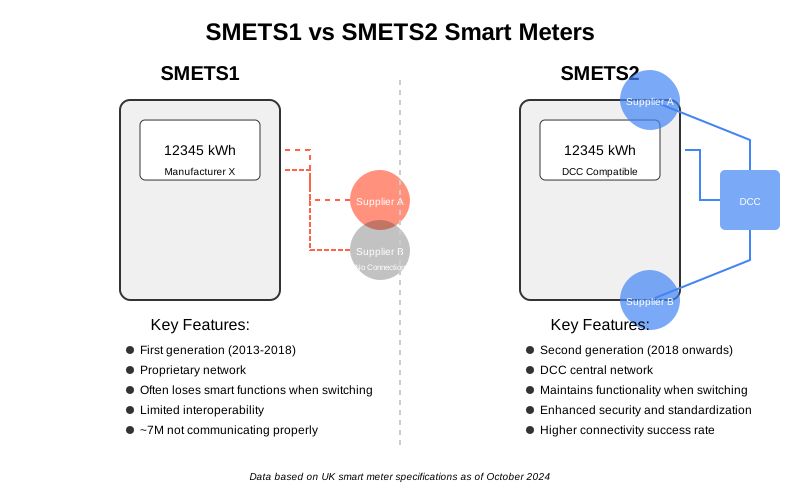
SMETS1 (Smart Metering Equipment Technical Specifications 1)
- First generation of smart meters deployed in the UK
- Communicate with suppliers through a mobile network operated by the meter manufacturer
- Major limitation: often lose smart functionality when consumers switch energy suppliers (“going dumb”)
- Installation period: mostly 2013-2018
SMETS2 (Smart Metering Equipment Technical Specifications 2)
- Second generation of smart meters
- Communicate through the Data Communications Company (DCC) network
- Maintain functionality when switching suppliers
- More secure and standardized
- Installation period: from 2018 onwards
Smart Meter Statistics in the UK
As of my last update (October 2024), there were approximately:
- 30 million smart and advanced meters operating in UK homes and small businesses
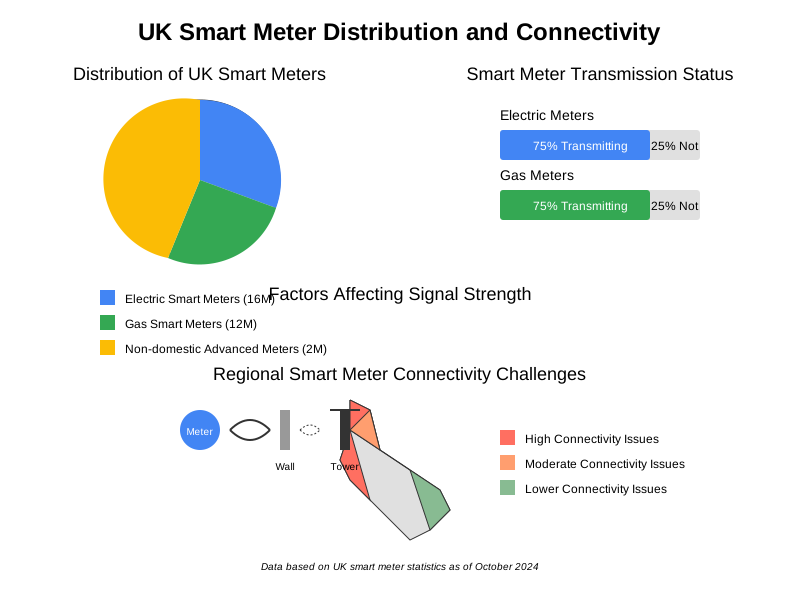
- About 16 million electric smart meters and 12 million gas smart meters in domestic properties
- The remainder being advanced meters in smaller non-domestic sites
Transmission Issues
Approximately 20-25% of all installed smart meters are not communicating properly with energy suppliers. This breaks down as:
- Around 4 million electric meters not transmitting data
- Approximately 3 million gas meters not transmitting data
The majority of non-communicating meters are SMETS1 devices that lost their smart functionality after consumers switched energy suppliers.
Regional Challenges
There are significant regional variations in smart meter connectivity:
- Rural areas generally experience more connectivity issues than urban areas
- Scotland, Wales, and parts of Northern England have higher rates of non-communicating meters
- Remote areas like the Scottish Highlands and Islands face particular challenges
- Dense urban environments with many high-rise buildings can also experience connectivity problems
Signal Strength Factors
Signal strength makes a significant difference to smart meter functionality:
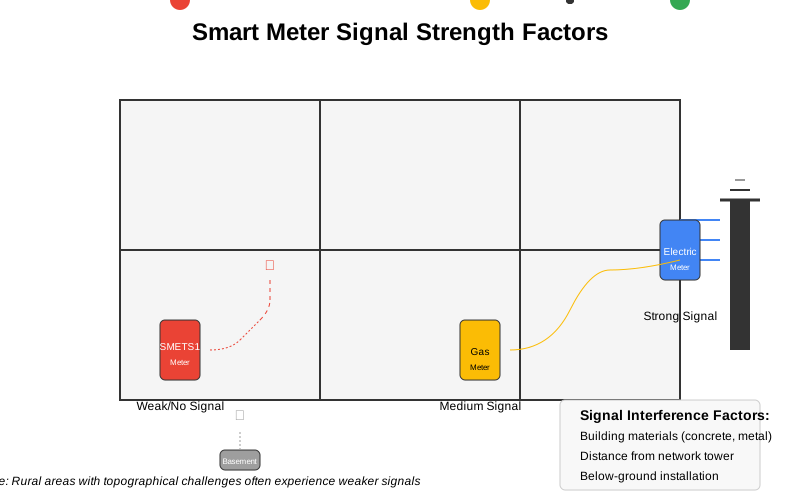
- Physical barriers (thick walls, metal infrastructure) can block signals
- Location of meters (basements, internal cupboards) affects transmission quality
- Local topography impacts wireless signal propagation
- Distance from cellular towers or network access points
- Weather conditions can temporarily affect signal quality
The UK government and energy suppliers are working on solutions including:
- The DCC network upgrade to connect SMETS1 meters to the central network
- Alternative communication technologies for areas with poor cellular coverage
- Signal boosters for properties with challenging physical characteristics
I would be happy to create some visual data representations of these statistics if you’d like to see the information in graphic format.
.
3 Seperate Report similar in content using the different platfoms
MAKE CONTACT TODAY FOR YOUR AI SUPPORT